PPF Tensile Strength & Elongation Standards: Engineering Guide
A technical breakdown of ASTM standards, tensile strength, elongation percentages, and topcoat rupture thresholds for paint protection film installers and distributors.
By Eguard AI
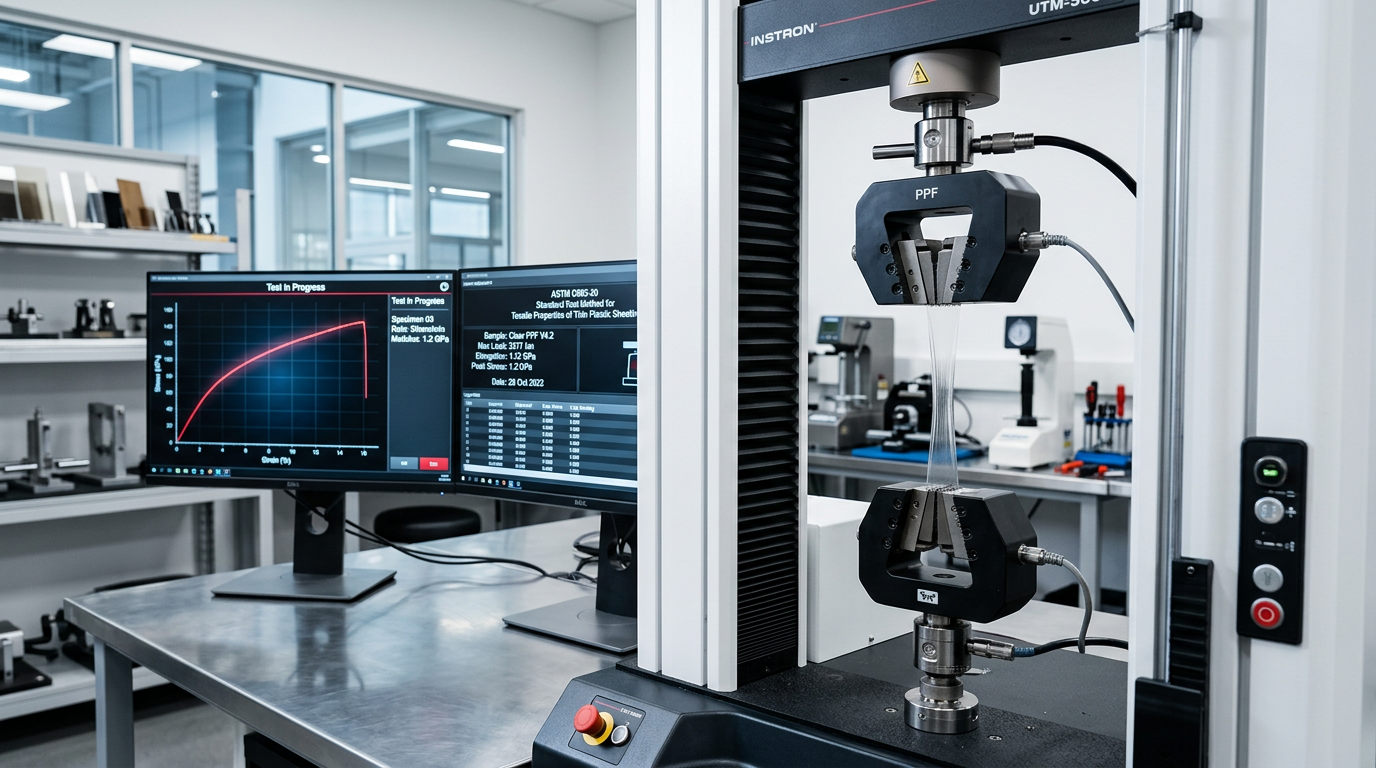
When evaluating automotive surface protection, physical endurance is dictated by measurable mechanical properties. For detailing studios, high-end restyling shops, and international distributors across the Middle East and GCC, understanding paint protection film tensile strength and elongation percentage test standards separates marketing claims from field performance.
Installing film over complex compound curves—such as aggressive front bumpers, deep mirror recesses, and wide quarter panels—places extreme mechanical demands on thermoplastic polyurethane (TPU). Here is how standardized testing governs elongation, tensile limits, and installation outcomes in demanding operational environments.
Understanding ASTM Test Standards for PPF Tensile Strength
Standardized laboratory testing ensures consistent baseline measurements across raw TPU films, topcoats, and pressure-sensitive adhesives (PSA). The automotive film manufacturing industry primarily relies on two standardized protocols established by ASTM International:
- ASTM D882 (Standard Test Method for Tensile Properties of Thin Plastic Sheeting): Applied to films under 1.0 mm (0.04 in) in thickness. A universal testing machine pulls strip specimens at a controlled crosshead speed (typically 500 mm/min) to determine yield strength, tensile break strength, and elongation.
- ASTM D412 (Standard Test Methods for Vulcanized Rubber and Thermoplastic Elastomers): Uses die-cut dumbbell specimens to evaluate tensile stress, elastic modulus, and strain recovery under tension.
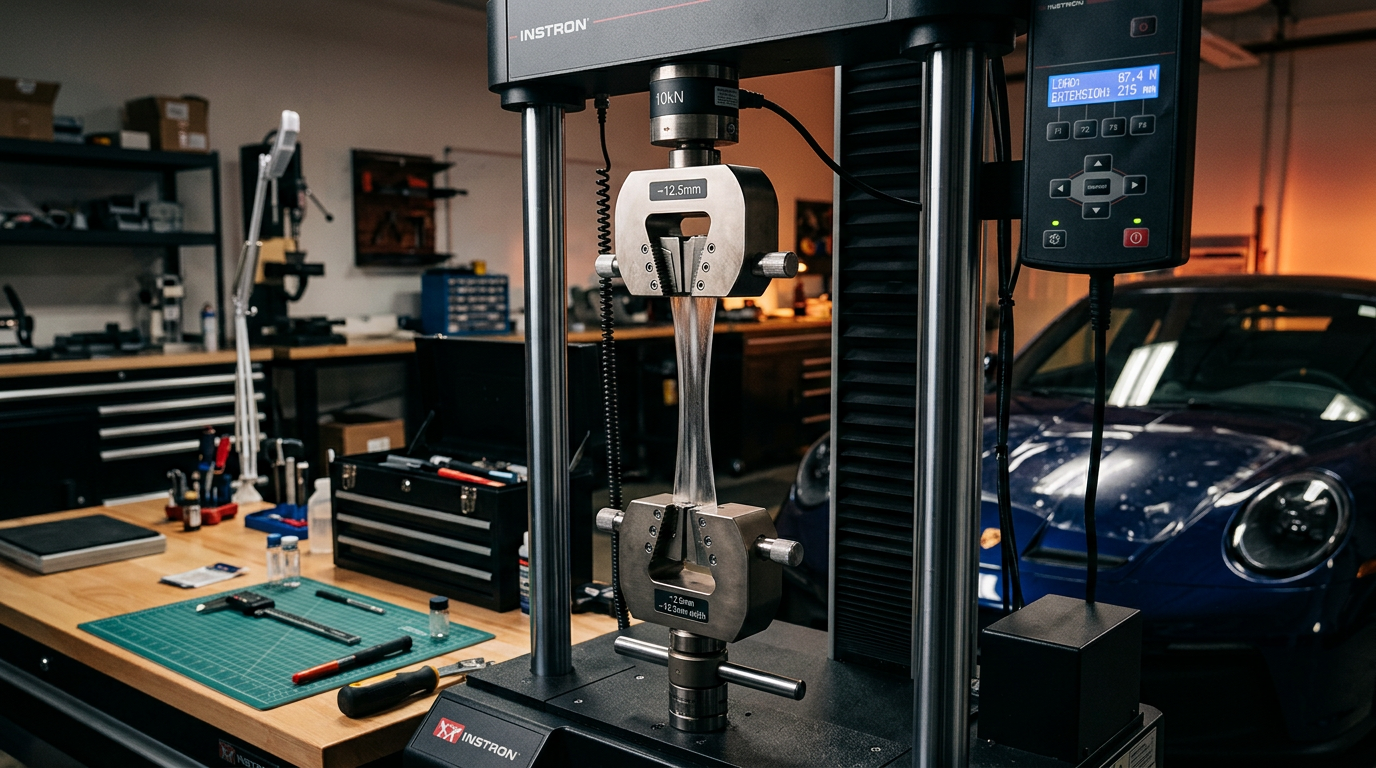
Tensile Strength vs. Elongation at Break: Core Definitions
To interpret technical data sheets (TDS) accurately, film professionals must differentiate between raw resistance and flexibility:
- Tensile Strength (MPa or PSI): The maximum mechanical pull stress a film can withstand before structural rupture. High-grade aliphatic TPU typically exhibits tensile strength ratings between 28 MPa and 45 MPa (4,000 to 6,500 PSI).
- Elongation at Break (%): The percentage increase in specimen length before complete material failure. Premium automotive PPF achieves elongation ratings between 300% and 450%.
- Modulus of Elasticity (Young's Modulus): The measure of film stiffness during the initial pull phase. A lower modulus indicates a more pliable film that conforms easily to body lines without excessive heat.
The Real-World Dynamic: Topcoat Rupture vs. TPU Base Stretch
A critical mistake in film evaluation is confusing total TPU elongation with usable installation stretch. While the base TPU layer may stretch beyond 350% under ASTM D882 testing, the cross-linked self-healing topcoat behaves differently.
What Is Topcoat Micro-Fracturing?
Most premium films utilize a dense, high-density polymer or ceramic-infused topcoat engineered for hydrophobic performance, chemical resistance, and self-healing. When an installer stretches a film beyond 25% to 35% in localized areas, micro-fracturing of the topcoat can occur. This yields:
- Premature loss of gloss and orange-peel distortion.
- Permanent haze or cloudy stress marks along edge wraps.
- Compromised self-healing and hydrophobic properties in overstretched zones.
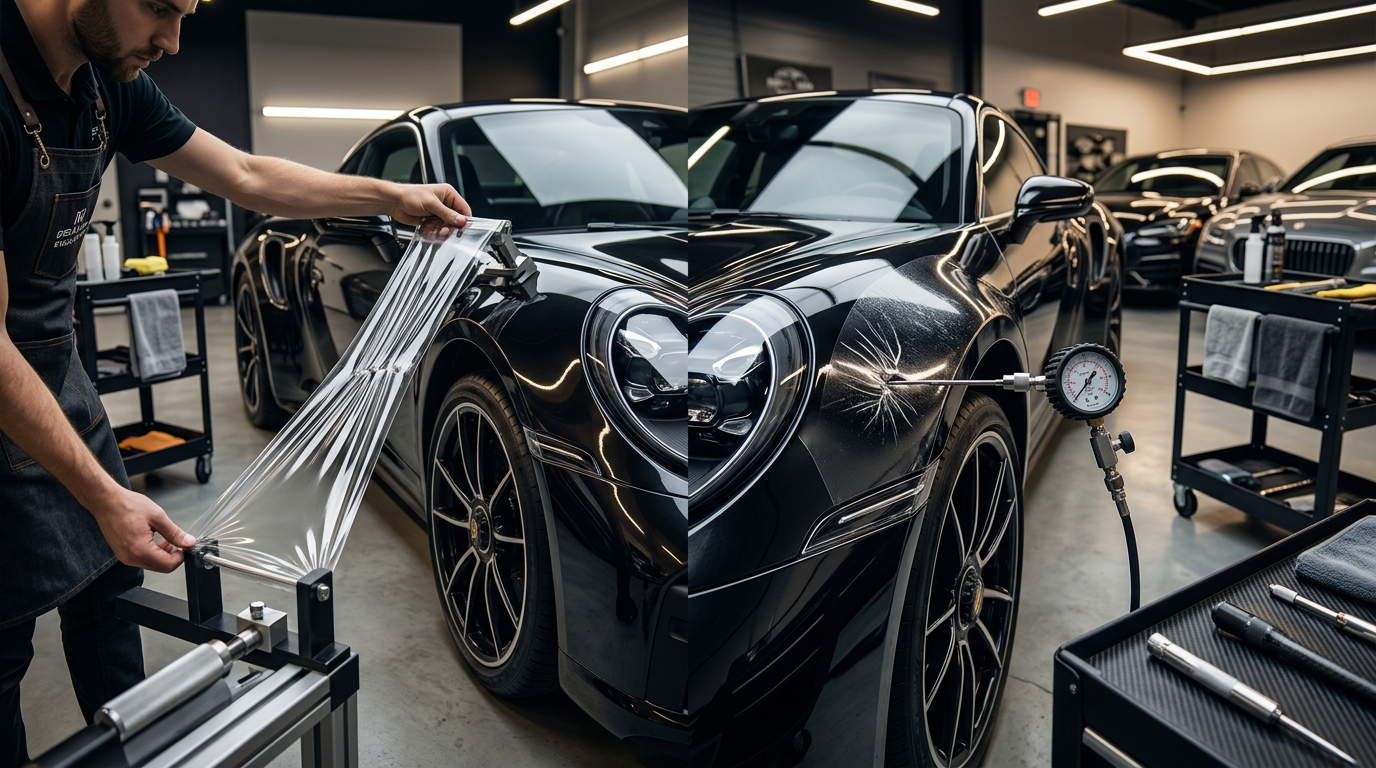
How Lab Specs Translate to Compound Curved Bumper Installs
In practical installation environments across Kuwait, Saudi Arabia, the UAE, Qatar, Bahrain, Oman, Jordan, and Iraq, tensile metrics dictate how the film behaves when manipulated around deep recesses and severe radius edges under extreme climatic conditions:
- Tension Distribution: Quality films with balanced tensile strength disperse tension evenly across the sheet instead of necking down in one localized weak spot.
- Adhesive Shear Resistance: High elongation must be matched by high-tack, shear-resistant acrylic adhesive. If film stretch produces excessive recoil force, the adhesive will lift, causing silvering, edge peel, or finger lift.
- Thermal Memory & Elastic Recovery: Superior aliphatic TPU films retain predictable elastic memory. Minor stretch lines and tension marks relax when activated by hot water, steam, or ambient heat.
Installers working in high-heat climates across the GCC experience softened TPU matrices due to ambient shop temperatures, requiring disciplined stretch management to avoid overextension and adhesive distortion.
Technical Benchmark: Eguard PPF Engineering Standards
As a manufacturer of premium surface protection solutions, Eguard Car Care benchmarks its paint protection film products against rigorous international standards to ensure optimal field workability without sacrificing impact resistance against sand, gravel, and environmental degradation.
| Technical Parameter | Standard / Protocol | Typical High-Grade Spec | | :--- | :--- | :--- | | Base Material | FT-IR Analysis | 100% Polycaprolactone Aliphatic TPU | | Total Thickness | Micrometer Gauge | 8.0 mil (200 microns) excluding liner | | Tensile Strength | ASTM D882 | > 30 MPa (> 4,350 PSI) | | Elongation at Break | ASTM D882 | > 350% | | Topcoat Functional Stretch | Factory Stress Test | Up to 35% without optical defect | | Puncture Resistance | ASTM D4830 | High-impact resistance threshold | | 180° Peel Adhesion | ASTM D3330 | Reinforced tack after 24h cure |
For detailing studios and restyling centers looking to supply reliable surface protection solutions, explore our comprehensive range of paint protection film, window protection film, and nano-ceramic window tinting in our products catalog, or review our warranty standards.
Summary for Installers and Distributors
- Do not rely on Elongation at Break alone: A 400% elongation rating does not mean the finished film can be stretched 400% on a bumper.
- Look for balanced tensile strength: High tensile strength resists puncture from road debris; moderate initial modulus allows clean corner wrapping.
- Maintain installation control: Keep localized stretch under 25–30% to protect the self-healing topcoat layer from optical deformation.
Ensure your workshop or distribution network utilizes verified, lab-tested films engineered for durability, optical clarity, and extreme climate endurance.